


Redistricting Fight Intensifies Across U.S. as States Race to Reshape Congressional Power

The Black Insider, May 8, 2026 - A high-speed redistricting fight is causing a shift in the political landscape in one or more states, directly affecting congressional districts, state-level political power, and the voting power of urban, rural, and minority communities.
The new surge comes after Louisiana secured a victory in the U.S. Supreme Court that struck down one of the more significant provisions of the Voting Rights Act, which addressed race and representation in the legislature. Since then, there has been a rush among Republican-led states to rework maps in Florida, Tennessee, Alabama, and Louisiana, with Democratic-led states trying to take steps to protect themselves, including California and Virginia. Mid-decade redistricting occurs at the slowest rate since the 1800s, according to the National Conference of State Legislatures.
The biggest question is who will control the U.S. House. In Texas, redrawing districts for the Republicans resulted in more Texas Republican seats. Gov. Greg Abbott said the new districts were more reflective of Washington representation, “the values of our state.” In reaction to that, voters in California approved a measure that permits temporary, legislature-drawn congressional maps until 2030 that would be in force until the outcome of the next census. Gov. Gavin Newsom's administration has described the move as being in response to the Republican “redistricting war.”
Florida is one of the latest major states where the governor has approved a new map of the districts for Congress. The map could add up to four more congressional seats to the Republicans, making the state's delegation more heavily skewed Republican than it currently is, 20 to 8. There are already lawsuits pending against the map, and opponents say it is in violation of the state's Fair Districts Amendment.
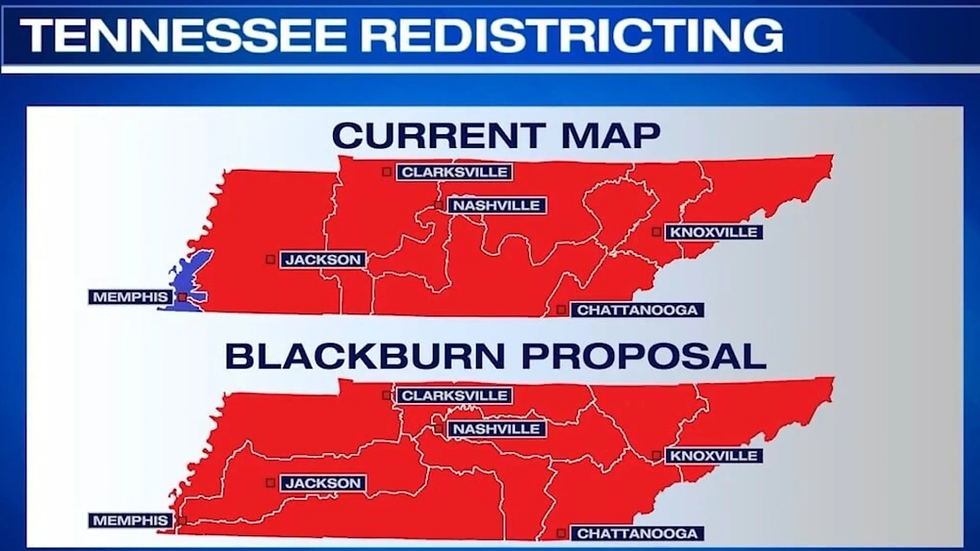
Tennessee's Republican-led legislature also passed a new congressional map that eliminates a majority-Black Memphis district held by Democrat Steve Cohen. The new map divides Shelby County into three districts that are preferred by Republican voters, and may allow Republicans to control every seat in the state's U.S. House delegation. Republican state Rep. Jason Zachary said the map presents an opportunity for “an all-Republican delegation,” while Democratic state Rep. Justin Jones called it “a form of Jim Crow terror.”
The opposite was true in Virginia, and their effort was thwarted. On May 8, the Virginia Supreme Court invalidated a redistricting plan provided by the General Assembly and adopted by the voters, finding that the legislature did not follow the proper procedure when it put the amendment on the ballot. The new map was designed to provide Democrats as many as four extra U.S. House seats. Don Scott, the Democratic speaker of the Virginia House of Delegates, declared the voters had “spoken loud and clear” while Richard Hudson, chairman of the National Republican Congressional Committee, said, “We're on offense.”
Other states in the redistricting wave include North Carolina, Missouri, Ohio and Utah. North Carolina has adopted a congressional plan for the next election, and Missouri's congressional plan is currently being litigated and is subject to a referendum. New congressional maps were adopted in Ohio via its redistricting commission, and Utah's new map was the result of court action following a lawsuit over the state's redistricting process.
It's not just Congress that's affected. Redistricting also impacts state political power because the state House and Senate districts determine which party controls the legislature, which in turn drives future redistricting, voting rules and election laws, as well as congressional mapmaking. North Carolina's own redistricting page notes that representatives to the U.S. House, North Carolina House and North Carolina Senate are elected by district, and that litigation can influence the choice of whether or not a plan is adopted.
Authorities in Alabama are requesting that the Supreme Court grant them a new opportunity to use a Republican-drawn congressional map that was rejected under the state's new Voting Rights Act, and a case that could potentially impact two Senate districts in the state. Miss. Gov. Tate Reeves is ready to draft a new plan for Supreme Court districts in Mississippi in response to a federal judge's ruling that Black voting power had been diluted.
The new maps could be seen as limiting the power of Black voters and other minority groups to elect candidates of their choice, particularly in the South, says voting-rights advocates. The new maps supporters say are legal because they are based on partisan voting and are reflective of the states' political wishes.
The battle will go on in court. Tennessee has two lawsuits contesting its new map ahead of the Aug. primary. The new map for Florida has been challenged in court. A state Supreme Court case in Missouri is scheduled for the summer of 2025 to determine whether its map should stay in place for a referendum that is underway.
Districts have morphed into the most critical political issue in the nation with the 2026 mid-term elections just around the corner. The final maps have the potential to not only affect several congressional seats as well as who gets to represent them, but they can also have a lasting impact on how communities are represented in state capitals and Washington for years to come.


Comments