


Tennessee Redistricting Fight Raises New Alarm Over Black Political Power and Modern Redlining
The Black Insider
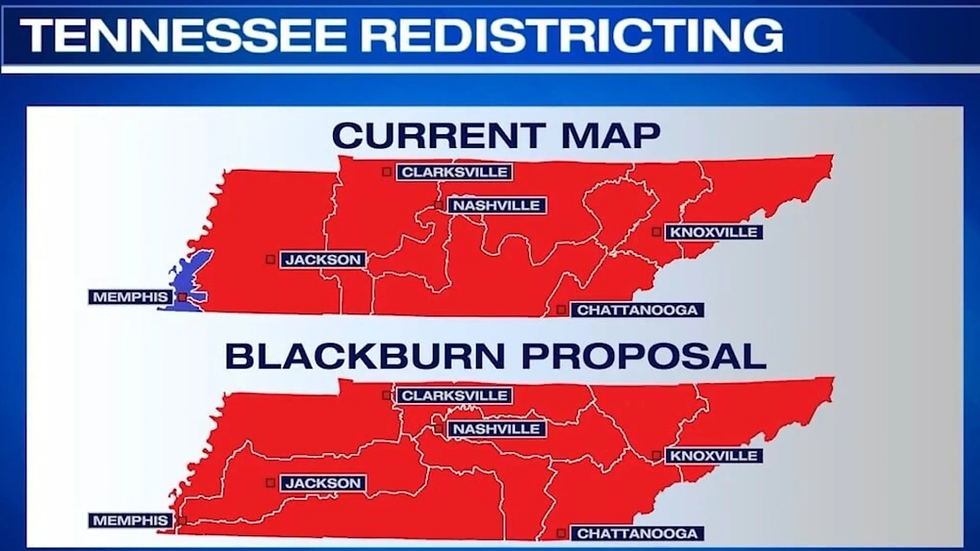
Tennessee has become the center of a new voting rights battle after Republican lawmakers approved and Gov. Bill Lee signed a new congressional map that breaks apart Memphis’ majority-Black congressional district. The new map divides Shelby County, home to Memphis, into three Republican-leaning districts, giving Republicans a path to win all nine of Tennessee’s U.S. House seats in the 2026 midterm elections.
The move comes after the U.S. Supreme Court’s April 29, 2026 decision in Louisiana v. Callais, which weakened protections under Section 2 of the Voting Rights Act. That decision gave Republican-led Southern states more room to challenge or eliminate majority-Black districts that had previously been protected as a way to ensure minority voters had a fair opportunity to elect candidates of their choice.
Civil rights leaders and Democratic lawmakers are calling the Tennessee map a form of modern political redlining. Just as historic redlining blocked Black families from equal access to housing, mortgages, and wealth-building opportunities, critics argue this new redistricting plan uses political boundaries to weaken Black voting power. The NAACP Tennessee State Conference has already filed a lawsuit challenging the map, arguing that the mid-decade redistricting violates state law and the Tennessee Constitution.
The controversy is especially significant because Memphis has long been one of the South’s most important Black political and cultural centers. Under the new map, the city’s voting strength is split across multiple districts instead of being concentrated in one district where Black voters could strongly influence the outcome. Democrats argue that this fractures community power and limits the ability of Black Tennesseans to choose representation that reflects their interests.
Republican lawmakers have defended the plan, saying the map was drawn for political advantage, not racial discrimination. One Republican senator described the bill as Tennessee’s attempt to “maximize” partisan advantage. However, Black lawmakers and civil rights groups say the racial impact cannot be ignored when a majority-Black city is divided in a way that benefits mostly white, Republican-leaning districts.
The word “redlining” also carries a separate legal meaning in housing and banking. The U.S. Department of Justice defines redlining as lenders discouraging applications, denying equal access to home loans, or avoiding credit services in neighborhoods because of the race, color, or national origin of the people who live there. Federal fair-lending laws, including the Equal Credit Opportunity Act and Fair Housing Act, still prohibit credit and housing discrimination.
At the same time, new federal fair-lending rules are creating concern among housing advocates. On April 22, 2026, the Consumer Financial Protection Bureau issued a final rule under Regulation B that changes how the Equal Credit Opportunity Act is interpreted, including provisions involving disparate impact, discouragement of applicants, and special purpose credit programs.
The rule is scheduled to take effect July 21, 2026.
For Black communities, the Tennessee redistricting fight is about more than one congressional seat. It is about whether political power, housing access, lending access, and civil rights protections are being narrowed at the same time. From the ballot box to the bank, advocates say the concern is the same: policies that appear technical on paper can carry deep consequences for Black representation, Black wealth, and Black opportunity.


Interestingly, all aspects are addressed by the law about foreign influence of democratic American elections and senator Massie, who AIPAC spent a minimum of $35 million against him to unseat, seems to me illegal! But that’s normal! But it does expose AIPAC corruption of the American political system!